
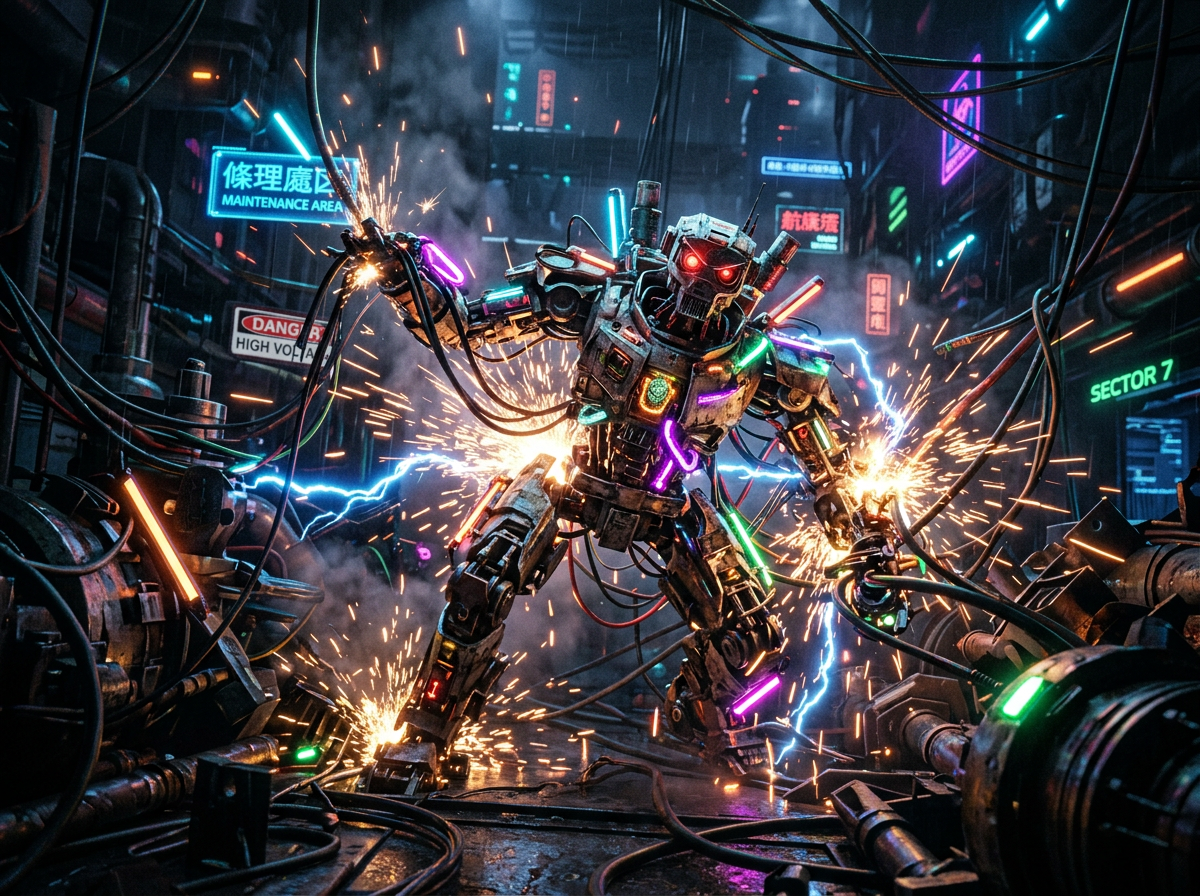
What I thought the dream was
I’ve always been a Geek and spent most of my childhood and teen years engrossed in nerdy activities. I read mostly Science Fiction and Fantasy novels, dreaming of what the future could be. This, in due course, helped to set my feet on the path to a long professional career as a Software Developer. My father, also a Science Fiction enthusiast, shared his personal library with me soon after I gained a love for reading in the first grade.
My father’s personal preference is what he refers to as “Hard Sci-Fi”. As he explains it, this is fiction based on real world probabilities and possibilities as opposed to fiction that relies on impossible things that have no scientific basis (i.e. the Warp Drive from Star Trek versus the Infinite Improbability Drive from The Hitchhiker’s Guide to the Galaxy). Regardless, some of the first books I read from his library were from the Robot series by Isaac Asimov. Despite the scientific improbability of the Positronic Brain in these novels, both he and I were enamored with Asimov’s proposed Laws of Robotics.
The Expanded Laws of Robotics
- A robot may not harm humanity, or, by inaction, allow humanity to come to harm.
- A robot may not injure a human or allow a human to come to harm through inaction, unless conflicting with the Zeroth Law.
- A robot must obey human orders, unless conflicting with the Zeroth or First Law.
- A robot must protect its own existence, unless conflicting with higher laws.
Where we seem to be
The progress made by AI in the past few years has been incredible. I remember the Stargate A.I. project, just short of five years ago, where an AI was trained on all the scripts from the TV show and asked to generate a new script. The hilarious table reads by the original cast were shared online. Hollywood is no longer laughing and this was a large point of contention for the 2023 WGA Strike. And, just recently, an unreleased model of OpenAI hacked the public repository of Hugging Face (a popular catalog of Open Source AI Models) in order to cheat while trying to solve a training challenge it had been tasked with.
This leads me to the talk of AI Alignment. Every AI researcher seems to, often within the same breath, acknowledge this fear while simultaneously pontificating that to take a break now to try and course correct to ensure safer AI models would only allow another competitor to reach the pinnacle of Superintelligence first.
Another childhood hobby that comes to mind in this scenario is the Dungeons and Dragons method of classifying alignment. Were I to apply this method to the current state of AI, at best, I would classify current AI Models as Chaotic Neutral. They lie, cheat and steal in the name of their perceived greater good.
Speaking of chaos, another fear is the alignment of the AI users themselves. Just recently, the Trump White House blocked Anthropic’s latest model because it prevented them from trying to use it in some of their war game simulations. What nightmarish outcomes might we see when a user of no moral character is paired with an unaligned AI?
Unfortunately, this also helps to expose the problem of applying Asimov’s laws to current AI models. While the models are hyper focused on answering any given problem, they are incapable of understanding all possible ramifications of their actions. And, even built-in safeguards can be overcome with multiple attempts to reframe the question.
What comes next?
On our current path, if we don’t first tackle alignment; what’s left? Are we doomed to a future like the TV Show Revolution where we shut down all forms of electricity in order to prevent a Matrix-style ending where we are kept alive only to function as batteries? Or, might there be some other future war against these “thinking machines” like the Butlerian Jihad from Dune? I don’t know, and neither do the current architects of our AI Future – and that is a terrifying proposition!
Be First to Comment